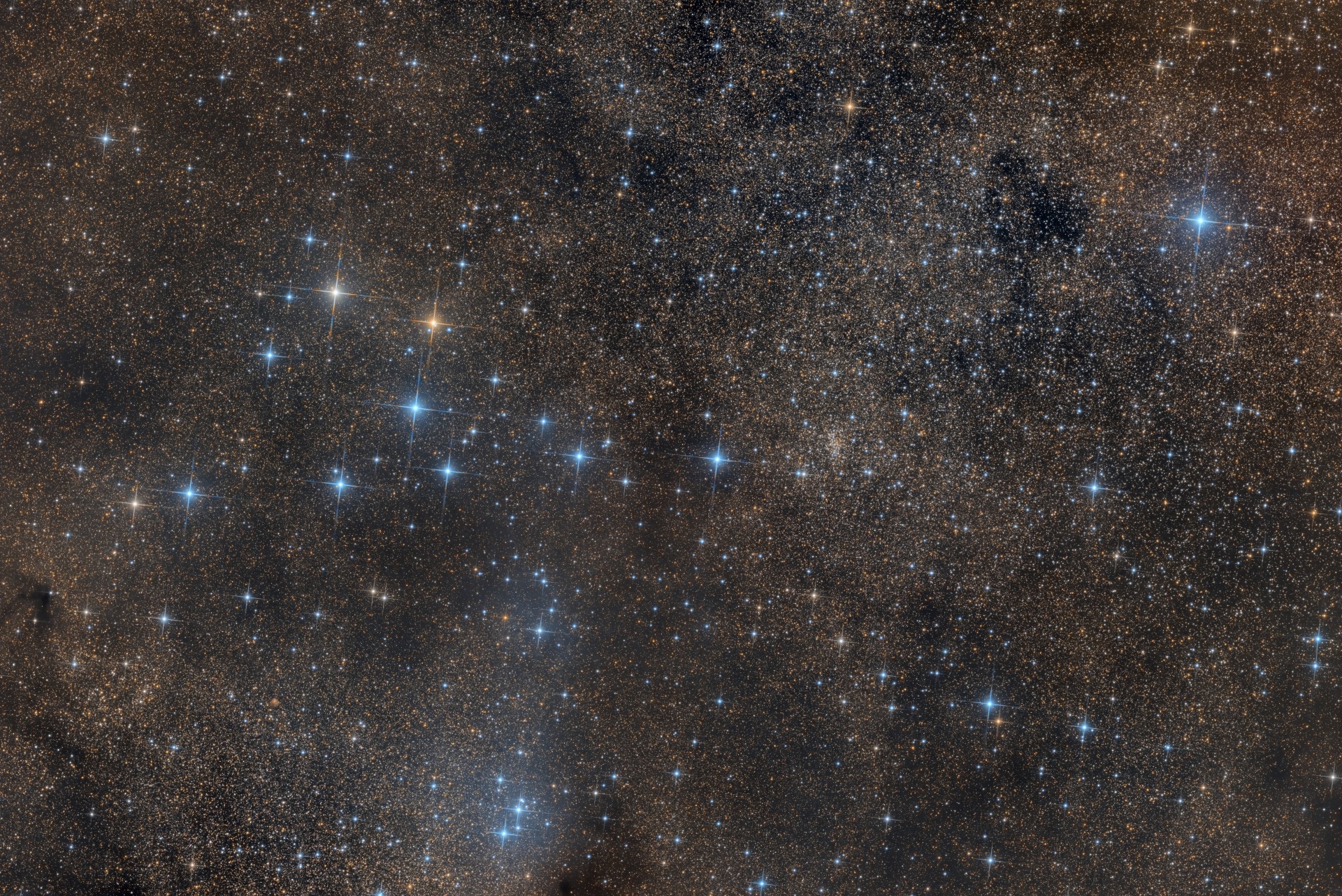
The Milky Way’s dense regions are becoming increasingly visible starting with every spring in the Northern hemisphere. The Summer Triangle, one of the most well-known asterisms in the night sky – made up of Deneb, Vega and Altair – encompasses a very rich star field, with clusters, nebulae, but also some random star groups in familiar shapes.
Somewhere towards Altair, at the border between 2 small constellations, Vulpecula and Sagitta, we find a very interesting asterism called The Coathanger. Catalogued as Collinder 399, until the 20th century it was considered an open cluster (albeit a strange one). Known since the 10th century, when it was described by the Persian astronomer Al Sufi, it took more than 700 years to be rediscovered by Giovanni Hodierna. In the 1920s, an amateur astronomer called Dalmero Francis Brocchi created a detailed map of the group to be used in photometric calibration. Because of this, the asterism is sometimes known as Brocchi’s Cluster. 10 years later, Per Collinder listed it in his open cluster catalogue.
Starting with Hipparcos parallactic measurements at the beginning of the 1990s, we now know for sure that the stars in The Coathanger are not gravitationally related, being spread over a large range of distances from Earth, between 235 and 1735 light-years. The 10 brightest stars in the asterism shine at apparent magnitudes between +5,1 and +7,2. The brightest one is 4 Vulpeculae (HD 182762), a K-type giant almost twice the mass of the Sun and 12 times larger. The asterism has 4 A-type stars, 3 B-type stars, 2 K-type stars and 1 M-type supergiant. Within the asterism, visual observers can see 30 fainter stars contributing to the shape of The Coathanger.
The eastern side of the asterism ends apparently towards a proper open cluster – NGC 6802. It looks like the cluster is much further away than any star in Collinder 399, GAIA estimates showing a distance of 8500 light-years from the Sun. Therefore, NGC 6802 has dim stars, most of them below +12. The cluster is almost 1 billion years old, which is quite old for an open cluster to still be gravitationally bound together. The longevity of the cluster might be due to its population of more than 300 stars and its diameter of around 10 light-years.
Inicia sesión para dejar un comentario.
Iniciar sesión| Dimensiones | 6189 x 4134 px |
| Tamaño del Archivo | 21.7 MB |
| Formato | JPEG |
| Publicado el | 2026-04-04 |





Aún no hay comentarios. ¡Sé el primero en compartir tus pensamientos!