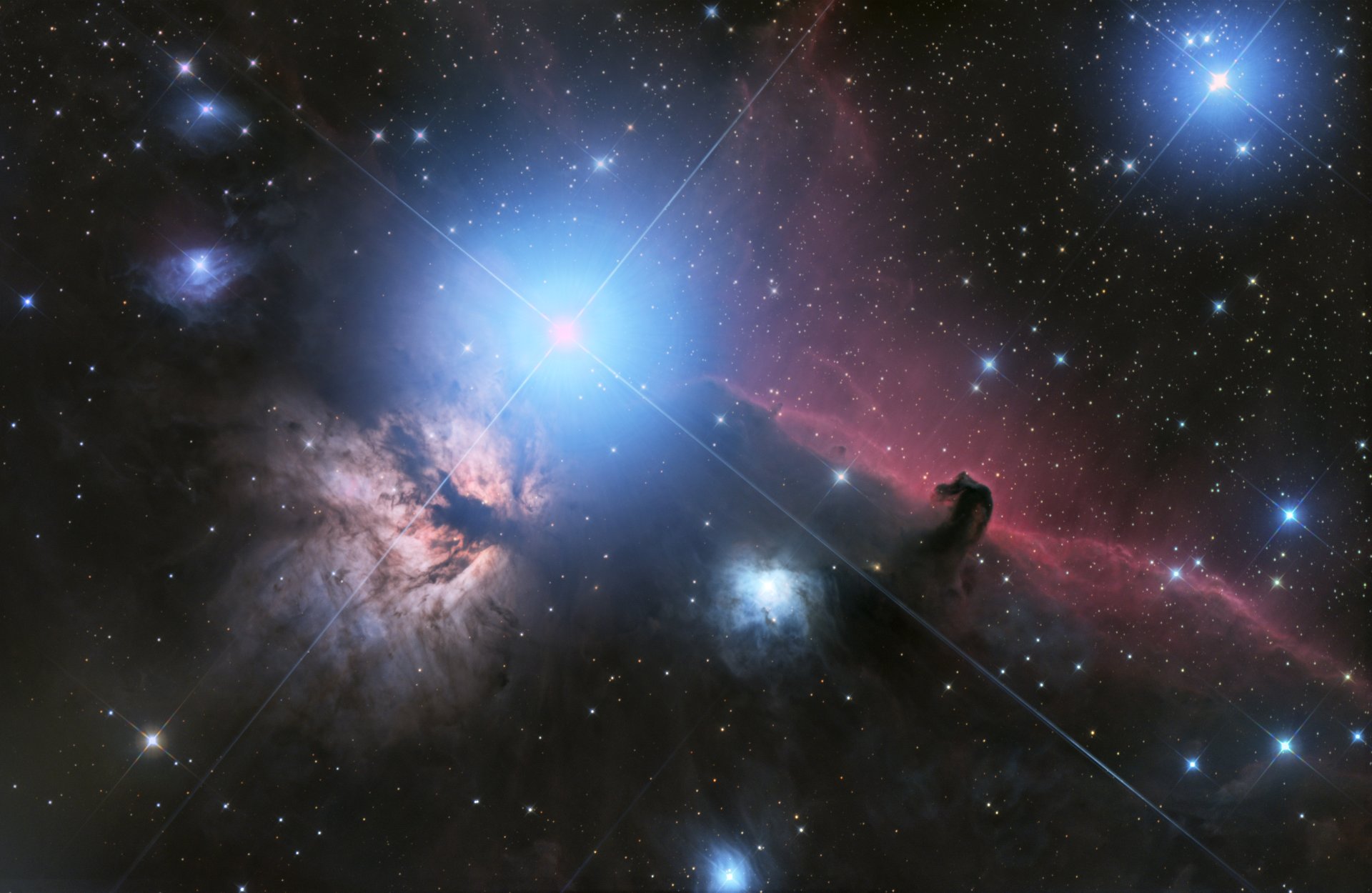
The workflow was as follows (in Siril)
- Crop, Image Plate Solving, Spectrophotometric Colour Calibration (SPCC)
- AutoBGE (background extraction)
- Denoising in GraXpert
- Starnet to create starless and starmask image
- Veralux Hypermetric Strech on starless image, Colour saturation tweaks and Veralux Revela for micro contrast tweaks
- Star Recomposition
- Final S curve adjustments
Zaloguj się, aby dodać komentarz.
Zaloguj się| Wymiary | 4735 x 3082 px |
| Rozmiar Pliku | 8.7 MB |
| Format | JPEG |
| Opublikowano | 2026-05-23 |
 © 2024 - 2026 AstrophotoMarket.com




very nice, way clearer and more beautiful than my edit! thanks for sharing!!! Good to see what is possible to get out of the data in post processing. greetings from Switzerland
Hi Mattia, thanks for the feedback. This wouldn't be possible without the excellent source FITS files (or source data) in the first place.
I've only just joined this group and am still learning. Can I ask was this image taken with your own equipment or do you request telescope time as one of the benefits of having a membership.
Hi! The image was taken with my own equipment. I have a Newtonian telescope Skywatcher Quattro Carbon with 800mm focal length combined with an Astro camera ZWO Asi071 MC pro. The mount is a Skywatcher EQ6r pro. Pretty old gears, but as long as I'm the limiting factor and not the gear there's no reason to get more modern equipment ;-) I imaged the Horsehead nebula from a beautiful bortle3 sky in the eastern part Switzerland at 1600m altitude in the night from 27 to 28 December 2025. I do not think that I would ever request telescope time but rather keep on imaging with my own equipment. At the beginning it's quite complicated and time consuming, getting a good result involves a lot of trial & error, but at the end seeing the result is highly rewarding, way more than downloading a dataset. For me, the complete process from start to finish is what makes this hobby so rewarding: the planning of the object to photograph, decide how to frame the object, figuring out the best parameters to use, generate the calibration files, being outside during the night for gathering the images and then the pre-processing and post-processing.
HI Mattia, that's awesome. I agree there is the satisfaction in using your own equipment and going through the entire process by trial and error. Unfortunately I live in a light polluted city (Bortle 7-8) and hoping to at least get some half-decent pics using the SeeStar S30 Pro. In any case, thanks for sharing. You're an inspiration and keep up the great work. John