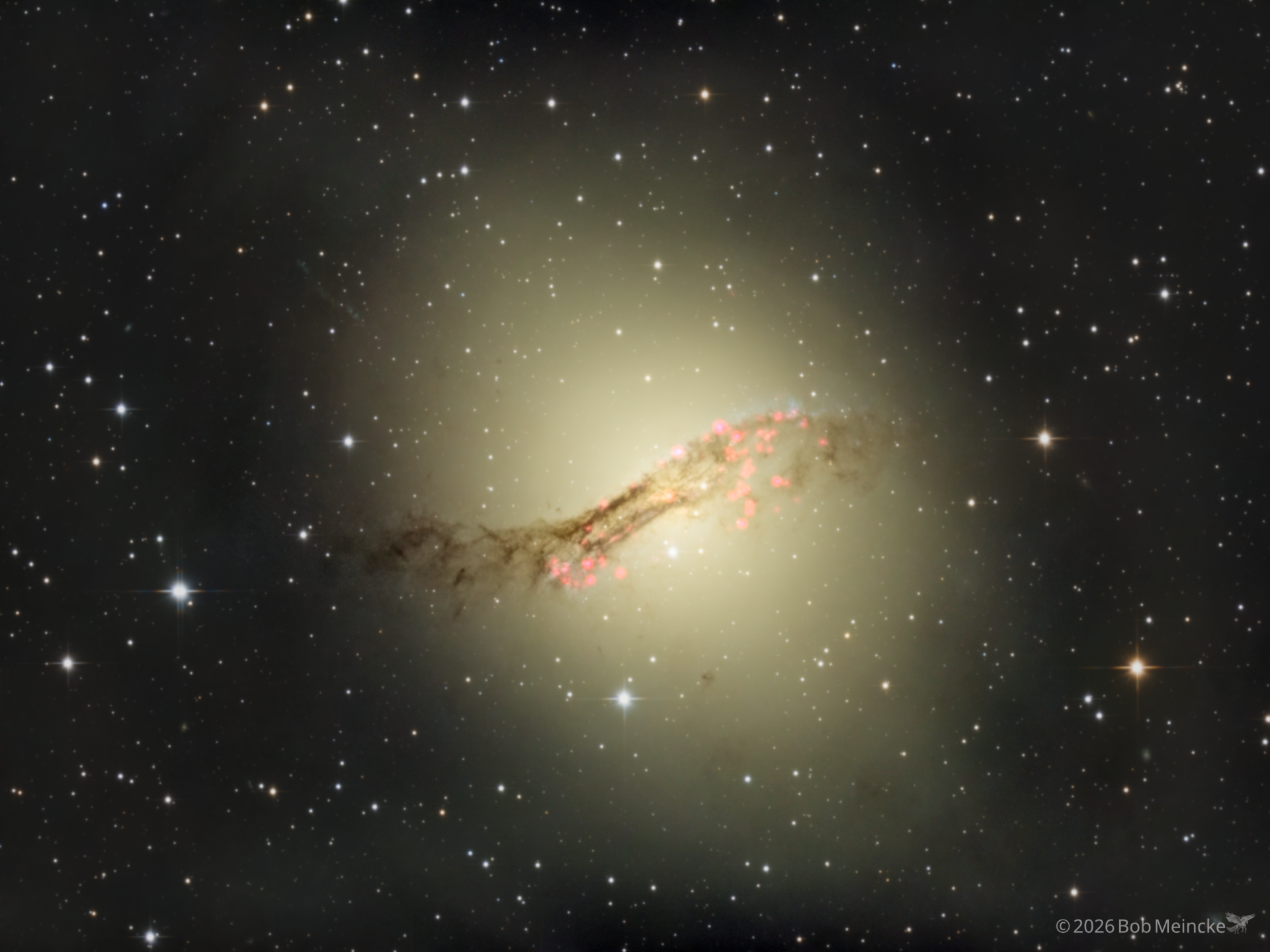
NGC 5128 — Embers Beneath the Dust
Centaurus A is one of the most distinctive galaxies in the southern sky — a giant elliptical galaxy crossed by a chaotic band of dark dust, the remnant of a past merger with a gas-rich companion. Roughly 12 million light-years away, that collision left behind the twisted lane that gives NGC 5128 its unmistakable appearance.
But hidden within that dust is something easy to overlook. The merger brought fresh gas into the galaxy and triggered new star formation. Scattered along the dust lane are compact H-alpha emission regions — small pockets of energized hydrogen glowing around young, hot stars. Against the enormous golden halo of Centaurus A, they appear less like a fire than **embers glowing beneath the dust**.
This image combines broadband data for the galaxy, stellar field and natural color with H-alpha extracted from narrowband data. Rather than allowing the H-alpha to tint the entire bright core, its contribution was localized to the emission regions within the dust structure. The result preserves the warm continuum glow of Centaurus A while allowing those small star-forming regions to emerge from within the lane.
At the galaxy's heart lies an active supermassive black hole, powering enormous relativistic jets and making Centaurus A one of the closest and best-studied active galaxies in the sky.
**NGC 5128 — a galaxy shaped by collision, divided by dust, with the embers of new stars still glowing inside.**
Inicia sesión para dejar un comentario.
Iniciar sesión| Dimensiones | 2600 x 1950 px |
| Tamaño del Archivo | 5.0 MB |
| Formato | PNG |
| Publicado el | 2026-08-18 |






Aún no hay comentarios. ¡Sé el primero en compartir tus pensamientos!